
Hospital Interior Design Firm In Delhi Ncr
By Nail and Hammer Pvt. Ltd.| Hospital Interior Design | Clinic Interior Design | Commercial Interior Design
Table of Contents
- What Does a Hospital Really Feel Like? We Believe It Should Feel Like Hope.
- Healing Isn’t Just Medicine. It’s Also Environment.
- Singh Nursing Home: Where Every Corner Has a Purpose
- Dashwanth Healthcare: Where Clinical Excellence Meets Human Scale
- Choosing a Hospital Interior Design Firm With One Standard of Care
- The Question We Always Ask
- Related Reading on Hospital Interior Design Firm
- Frequently Asked Questions About Hospital Interior Design Firm
Choosing the right hospital interior design firm can transform how patients, families, and staff experience a healthcare space. As a hospital interior design firm based in Delhi NCR, Nail and Hammer blends clinical function with warmth and calm, guided by principles of evidence-based healthcare design.
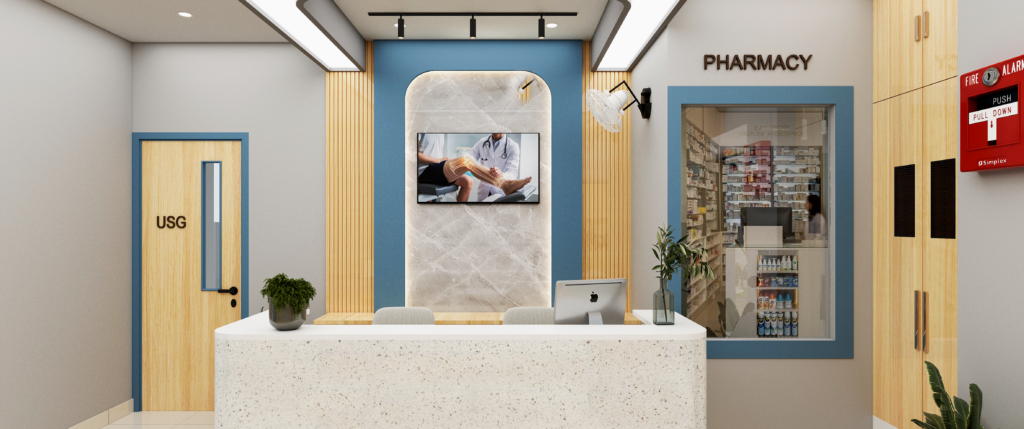
What Does a Hospital Really Feel Like? We Believe It Should Feel Like Hope.
There’s a moment — and if you’ve ever sat in a hospital waiting room, you know it — where the walls start to close in. The fluorescent light hums. The plastic chair digs into your back. The corridor smells like antiseptic and uncertainty. And somewhere in the middle of all that, a person is trying to hold themselves together while a doctor explains something that will change their life.
We think about that person a lot. In fact, that person is the reason we do what we do — whether we are crafting a full-scale hospital interior design, a warm and welcoming clinic interior design, or a high-performing commercial interior space for a healthcare brand.
Healing Isn’t Just Medicine. It’s Also Environment.
Decades of research confirm what we’ve always felt intuitively — patients recover faster, staff perform better, and families endure the hardest hours more peacefully when the space around them is designed with intention. This truth applies whether we are working on large multispecialty hospital interiors, a single-specialty clinic interior design, or a commercial interior design project for a diagnostic centre or pharmacy chain.
A calming color palette isn’t decoration. It’s physiology. Natural light isn’t aesthetic. It’s therapy.
Thoughtful wayfinding isn’t convenience. It’s dignity. Because when someone is frightened and in pain, they shouldn’t also feel lost. As a firm that specialises in hospital interior design, clinic interior design, and broader commercial interior design for the healthcare sector, we believe every square foot of a medical facility carries responsibility. This is the philosophy we bring to every project we take on — and two of the projects closest to our hearts right now are Singh Nursing Home and Dashwanth Healthcare — both multispecialty hospitals where we had the privilege of rethinking what a healing space could truly become.
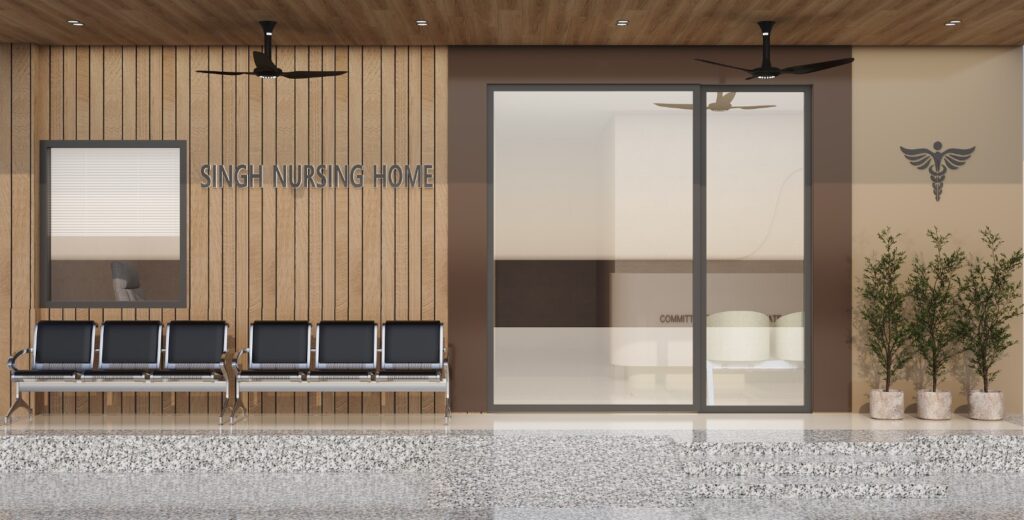
Singh Nursing Home: Where Every Corner Has a Purpose
When the team at Singh Nursing Home first brought us in, they said something that stuck with us:
Singh Nursing Home is a full-service multispecialty facility — which means on any given day, its corridors hold a new mother, a cardiac patient, a child nervous about a procedure, and an elderly man waiting for his orthopedic consultation. Approaching it as both a hospital interior design challenge and a human experience challenge, our team brought together the same sensitivity we apply to every clinic interior design and commercial interior design project: understand the people first, then design around them.
We chose a warm, earthy palette for the reception and waiting areas — moving away from the institutional blues and stark whites that dominate average hospital interior design and instead leaning into tones that whisper calm. We brought in soft indirect lighting that reduces glare and anxiety. We designed the patient flow so that people moving between departments never feel like they’re navigating a maze.
In the OPD areas, we created semi-private waiting pods — small but considered seating arrangements that give patients a sense of personal space even in a shared environment. It is the kind of thoughtful detailing we carry into every clinic interior design we undertake — because dignity matters, even in a waiting room.
For the nursing stations, we focused on ergonomics and sight lines — ensuring that staff could monitor patient areas comfortably while also having a workspace that didn’t leave them exhausted after a twelve-hour shift. Good commercial interior design for healthcare facilities always accounts for the people working inside them, not just the people visiting.
The result is a hospital that functions with the efficiency a multispecialty facility demands — and breathes with the warmth that people in vulnerable moments deserve.
Dashwanth Healthcare: Where Clinical Excellence Meets Human Scale
Dashwanth Healthcare came to us with a different kind of challenge.
They had already built a reputation for outstanding clinical outcomes across multiple specialties. Their doctors were excellent. Their equipment was state of the art. But the space — honest and functional as it was — didn’t yet reflect the quality of care happening inside it. They wanted their environment to finally match their ambition. In short, they needed their hospital interior design to speak as loudly as their clinical reputation.
For a multispecialty hospital like Dashwanth, the commercial interior design challenge is layered. You’re not designing one experience — you’re designing many. The mother bringing her child to pediatrics. The executive visiting cardiology. The patient navigating pre-op nerves in the surgical wing. Each journey through the building is emotional in its own way, and thoughtful clinic interior design principles — privacy, calm, clarity — had to be applied department by department.
We began with zoning — creating distinct visual identities for different departments while maintaining an overarching coherence that makes the whole facility feel unified. A patient moving from general medicine to diagnostics shouldn’t feel like they’ve walked into a different building. Cohesive hospital interior design ensures that the brand and the care feel consistent end to end.
We invested heavily in the entrance and reception experience, because first impressions in a hospital aren’t about luxury — they’re about reassurance. The moment someone walks through the door, the space should say: you’re in good hands here. At Dashwanth, we achieved this through grounded, welcoming commercial interior design — a reception with clear sightlines, thoughtful art, and staff positioning that makes finding help feel effortless.
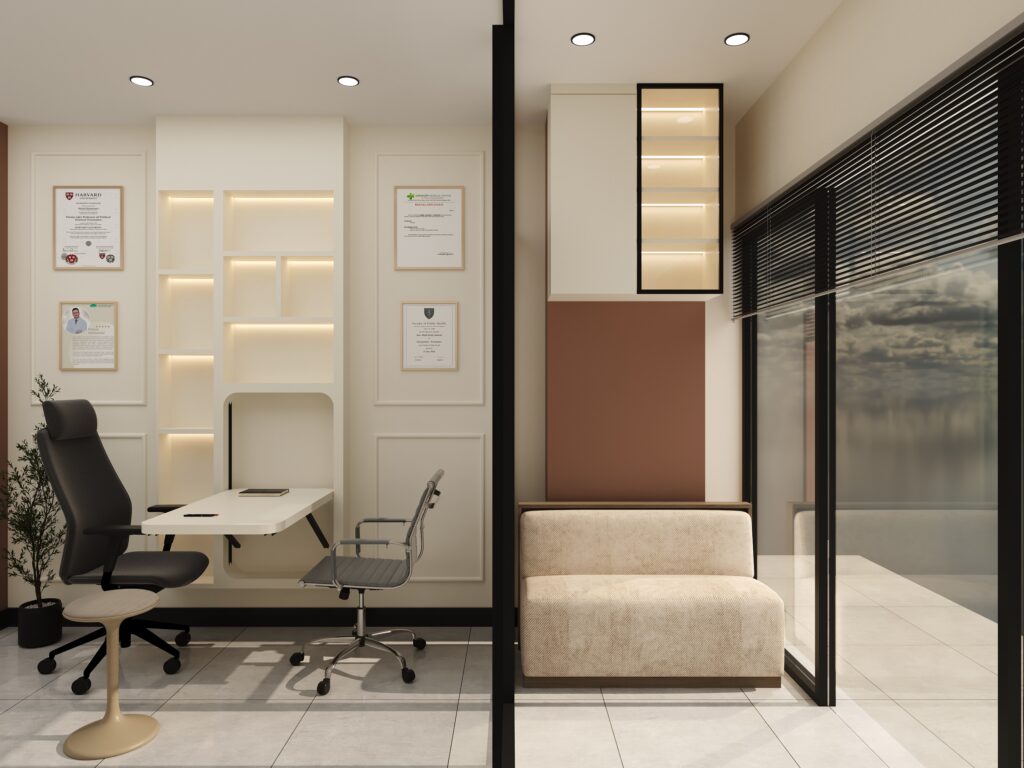
In the consultation rooms, we applied our clinic interior design philosophy — privacy, acoustic comfort, and calm — designing spaces where a doctor and patient could have a real conversation without the environment adding noise to an already significant moment.
The corridors at Dashwanth now have daylight integration wherever structurally possible. Where natural light couldn’t reach, we worked with the lighting team to create warmth rather than simply brightness. It’s a detail that elevates any hospital interior design from functional to genuinely healing. Patients may not consciously notice — but they feel it.
Choosing a Hospital Interior Design Firm With One Standard of Care
Our work doesn’t begin and end with large hospital projects. We bring the same rigour and empathy to clinic interior design for single-doctor practices, dental clinics, physiotherapy centres, and specialist OPDs. And we apply commercial interior design thinking — brand coherence, operational flow, customer experience — to diagnostic chains, wellness centres, pharmacy retail spaces, and corporate health facilities.
Whether a space holds ten patients a day or ten thousand, the human being at its centre deserves the same quality of thought. That’s not a business philosophy. That’s just the right way to design.
The Question We Always Ask
Before we draw a single line on a plan — whether it’s a hospital interior design, a clinic interior design, or a commercial interior design brief — we ask one question: What is this person feeling right now?
Not the patient in the abstract. The specific, frightened, hopeful, exhausted, relieved, anxious human being who will stand in this room — perhaps on one of the hardest days of their life.
If we can design a space that makes that day even fractionally more bearable — that gives them one less thing to worry about, one more reason to feel safe — then we’ve done our job.
That’s what hospital interior design means to us.
Not surfaces. Not specifications. People.
If you’re building or reimagining a hospital, clinic, or commercial healthcare facility and you’d like to talk about what thoughtful design could mean for your patients and your team, we’d love to have that conversation.
Looking to start a Clinic Interior Design project of your own? Explore our Clinic Interior Design services to see how Nail and Hammer can help bring your vision to life.